
Dom

Master's Thesis

  • Ekaterina Frolova
  •  MPhD 23

Dom stands for “home” and “house” in Russian.

This topic has always been sensitive in my family. My great-grandfather’s home was destroyed twice during dekulakization — the Soviet campaign of political repression.

After I was born, my mom and I were forced to move twice, in 2000 and 2019, for safety reasons. I left my country in 2022 after its government started the war against Ukraine and have not returned since.

The project explores different edges of feeling at home, losing home, and trying to find one. During my first two years of immigration, I had long conversations with my friends and neighbors from Russia and Ukraine, most of whom left their countries after the start of the war.

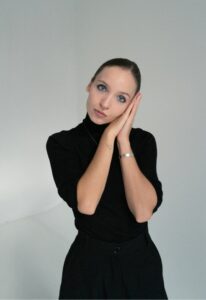
I photographed them in their current apartments abroad alongside objects that help create an ephemeral sense of home. In the end, these objects became only a thread, a starting point for untangling something deeper and far more complex.

Dom does not seek to compare the stories but to delve into the multiple dimensions of home and the questions that have followed me since childhood and have now become even more crucial.

Recently, I added another layer to the project. As a safety measure, I began covering my subjects’ faces with threads. They function both as protection and as a visual metaphor. There is an expression “to sew someone’s mouth shut,” meaning to silence a person. This echoes the fragile boundary between protection, self-censorship, and vulnerability.

V, 
photographed in Barcelona

.

“When you separate from the family, home becomes internal. It is a place where you can find peace. For, when there is chaos and anxiety, it’s unsettling, you’re outside your home.”

A, photographed in Prague

.

“When I don’t like the environment around me, I don’t even try to make it comfortable. It simply won’t feel like home to me. I can live like that for a year if I have to, but without the feeling of home.”

O, photographed in Limassol.
“Home is where you feel safe; where you’re surrounded with things that make your life easier and make you feel like you are standing on both feet, especially in the periods of turbulence. The magic wand is also about safety and protection; if it gets too hard, I can always call upon a patronus.”

S, photographed in Tbilisi.
“My little house has turned out to be surrounded by an alien atmosphere, ideology, ideas, and people. I never thought I would feel like a stranger among my own people, but it’s happened.”

Y, photographed in Barcelona.
“The feeling of home emerges once you allow yourself to keep things that serve no practical purpose. Those useless, yet such very useful things give you the feeling of significance, liveliness, and warmth.”

V, 
photographed in Barcelona

.

“When you separate from the family, home becomes internal. It is a place where you can find peace. For, when there is chaos and anxiety, it’s unsettling, you’re outside your home.”

A, photographed in Prague

.

“When I don’t like the environment around me, I don’t even try to make it comfortable. It simply won’t feel like home to me. I can live like that for a year if I have to, but without the feeling of home.”

O, photographed in Limassol.
“Home is where you feel safe; where you’re surrounded with things that make your life easier and make you feel like you are standing on both feet, especially in the periods of turbulence. The magic wand is also about safety and protection; if it gets too hard, I can always call upon a patronus.”

S, photographed in Tbilisi.
“My little house has turned out to be surrounded by an alien atmosphere, ideology, ideas, and people. I never thought I would feel like a stranger among my own people, but it’s happened.”

Y, photographed in Barcelona.
“The feeling of home emerges once you allow yourself to keep things that serve no practical purpose. Those useless, yet such very useful things give you the feeling of significance, liveliness, and warmth.”

I, photographed in Limassol.
“Now home is where I left my suitcase and where the bed I sleep in is, with no strings attached. But these earrings are a connection to my childhood home. My mom gave them to me when I was in elementary school, and I’ve been wearing them ever since. The more often I move, the more these earrings remind me of where my most beloved people live.”

D, photographed in Barcelona.
“When I think of home, I imagine mom cooking something in the kitchen. Dad watching TV. I come home, mom hugs me, and I smell freshly cooked soup. I sit down at the piano to play.

My mom and dad have already passed away. Mom died six years ago, and dad — just a week before the war started.”

M, photographed in Berlin.
“For me, home is a complicated topic, because for most of my life, I lived by the principle ‘anywhere to get out of here’. Only recently, I started to realize that there exists a sense of home.”

L, photographed in Paphos.
“Home is your habits. It’s hard to change your habits completely. That is why I lost my home in Russia. I don’t have a home now. Even though I used to.”

I, photographed in Limassol.
“Now home is where I left my suitcase and where the bed I sleep in is, with no strings attached. But these earrings are a connection to my childhood home. My mom gave them to me when I was in elementary school, and I’ve been wearing them ever since. The more often I move, the more these earrings remind me of where my most beloved people live.”

D, photographed in Barcelona.
“When I think of home, I imagine mom cooking something in the kitchen. Dad watching TV. I come home, mom hugs me, and I smell freshly cooked soup. I sit down at the piano to play.

My mom and dad have already passed away. Mom died six years ago, and dad — just a week before the war started.”

M, photographed in Berlin.
“For me, home is a complicated topic, because for most of my life, I lived by the principle ‘anywhere to get out of here’. Only recently, I started to realize that there exists a sense of home.”

L, photographed in Paphos.
“Home is your habits. It’s hard to change your habits completely. That is why I lost my home in Russia. I don’t have a home now. Even though I used to.”

author/s

Ekaterina Frolova

Budapest HU

MPhD 23

Tutor/s

Natasha Christia

Marta Dahó Masdemont

Arianna Rinaldo

More projects

Radici Erranti/Wandering Roots

Master's Thesis

  • Francesca Bari
  •  MPhD 24

Oh, To Swim

Master's Thesis

  • Adeline Rush
  •  MPhD 25

Heredosporium

Master's Thesis

  • Martina Orska
  •  MPhD 23